
Tetiana Khomenko on Music, the Balalaika, Ukrainian Culture and Finding Her Own Voice

For some musicians, an instrument is simply a profession. For Tetiana Khomenko, the balalaika
has been a lifelong companion, a means of artistic expression and a way to explore the cultural
world around her.
Born and raised in Kyiv, Tetiana began performing as a child and eventually built a career that combines performance, education, cultural management, producing and international artistic exchange. She holds a Master of Music degree from the P. I. Tchaikovsky National Music Academy of Ukraine and has worked as a soloist, concertmaster, teacher, methodologist and producer. She has created musical ensembles and concert-and-lecture programs and has been a member of the Balalaika and Domra Association of America (BDAA) since 2014.
Her artistic interests extend far beyond one instrument or one musical genre. Today, she sees music as a way to connect people, share experience and introduce international audiences to the richness of Ukrainian and Eastern European musical culture.
Gorozhanka: Tetiana, you have devoted most of your life to music. How did it all begin?
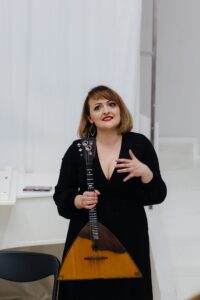
Tetiana Khomenko: My story began in Kyiv when I was a child. I first appeared on stage at the age of five, and at eight I chose the balalaika as my instrument. It was a very simple choice at the time — I was fascinated by its sound and appearance. I could not have imagined that this decision would become my profession and accompany me throughout my life.
I studied at a music school and later at the Reinhold Glière Kyiv Municipal Academy of Music and the P. I. Tchaikovsky National Music Academy of Ukraine. Very early on, I understood that becoming a professional musician required much more than talent. It required discipline, patience and many hours of practice.
Looking back, I sometimes think that I did not choose the balalaika. The balalaika chose me.
Gorozhanka: Your main concert instrument is the balalaika, but your musical background is much broader.
Tetiana Khomenko: Yes. I am a multi-instrumentalist in terms of my professional musical education. At the music college and at the National Music Academy of Ukraine, I studied Ukrainian traditional instruments as part of my training. This gave me a much broader understanding of Ukrainian and Eastern European musical traditions.
My main concert instrument has always been the balalaika, but I have also worked with orchestras and different chamber ensembles and performed with a mandolin orchestra. These experiences helped me understand the connections between different plucked-string traditions.
I was born and raised in Kyiv, and this is an important part of my artistic identity. Kyiv is a city with an exceptionally rich cultural history, and growing up there shaped my understanding of music as something diverse, dynamic and connected to people.
I hold a Master of Music degree from the P. I. Tchaikovsky National Music Academy of Ukraine.
My professional path has also included work as a performer, concertmaster, teacher, methodologist and cultural manager.
Gorozhanka: You have created several of your own musical projects. What interests you most as an artist?
Tetiana Khomenko: I am interested in discovering what an instrument can do beyond the expectations people have of it.
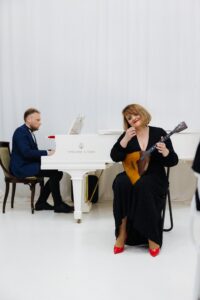
In 2013, I initiated the creation of BRAVO Band, and later I developed several projects combining balalaika with piano and other instruments. One of my favorite formats became a journey into Folk, Classical Music and Jazz: all the Faces of the Balalaika.
The concept was to show the audience that the balalaika is not limited to one musical style. We explored folk traditions, classical repertoire and jazz and worked with Ukrainian and international music.
For me, this is what makes being a musician exciting: you can respect tradition while continuing to search for something new.
Gorozhanka: You have also been a member of the Balalaika and Domra Association of
America for many years. What does this professional community mean to you?
Tetiana Khomenko: I joined BDAA in 2014, and the Association has been an important part of my professional development. I have participated in its annual conventions, where musicians and educators come together to perform, teach, exchange experience and discuss the future of our instruments.
For me, these conventions are much more than performances. They are a professional and educational environment. I value the opportunity to meet colleagues, learn from other musicians and share my own experience as a performer and specialist in Eastern European musical traditions.
I am particularly interested in the educational side of this work. I would like to continue contributing my experience to younger musicians and to projects that encourage cultural exchange.
Gorozhanka: After so many years as a professional musician, what would you like to pass on to the next generation?
Tetiana Khomenko: Experience becomes valuable when you can share it. I remember how important teachers and mentors were at different stages of my own development. A young musician needs technical knowledge, of course, but also an understanding of how to find an individual artistic voice.
That is why I am interested in educational projects that combine performance, musical traditions and cultural context. I want students to understand not only how to play a piece, but also where the music comes from and how they can make it meaningful for a contemporary audience. I believe that every generation has to find its own way of speaking through music.
Gorozhanka: Your career has included many different professional roles. What have you learned from having such a varied path?
Tetiana Khomenko: That you do not have to choose one definition of yourself for your entire life. I have been a performer, concertmaster, teacher, methodologist, manager and producer. Each role has given me something that later became useful in another part of my career. My path has not been completely linear, and I think that is a strength rather than a weakness.
You can learn something new without abandoning what you have already built. For women especially, I think it is important to remember that a professional life can evolve. You can change direction, start a new project, learn a new skill and still remain connected to your original passion.
Gorozhanka: What is the next chapter of your creative life?
Tetiana Khomenko: I want to continue working at the intersection of music, culture and education.
As a performer, I want to keep exploring new repertoire and new possibilities for the balalaika. As an educator and cultural professional, I want to share my experience and contribute to international cultural exchange.
I am especially interested in Ukrainian and Eastern European musical heritage and in presenting it to contemporary audiences in ways that feel alive rather than purely historical.
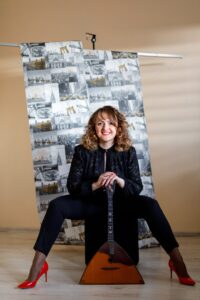
After more than three decades in music, I still practice every day and still have things I want to learn. That is probably the best part of being an artist: there is always another piece of music, another collaboration and another idea waiting for you.
Gorozhanka: And what would you say to a woman who is thinking about starting something new?
Tetiana Khomenko: Do not wait until you feel completely ready. Some of the most important decisions in my life happened when I did not have all the answers.
You learn, you make mistakes, you change direction and you continue.
You do not have to follow a perfectly straight path. You can build your own.
And sometimes the thing that makes your path unusual is exactly what makes it yours.