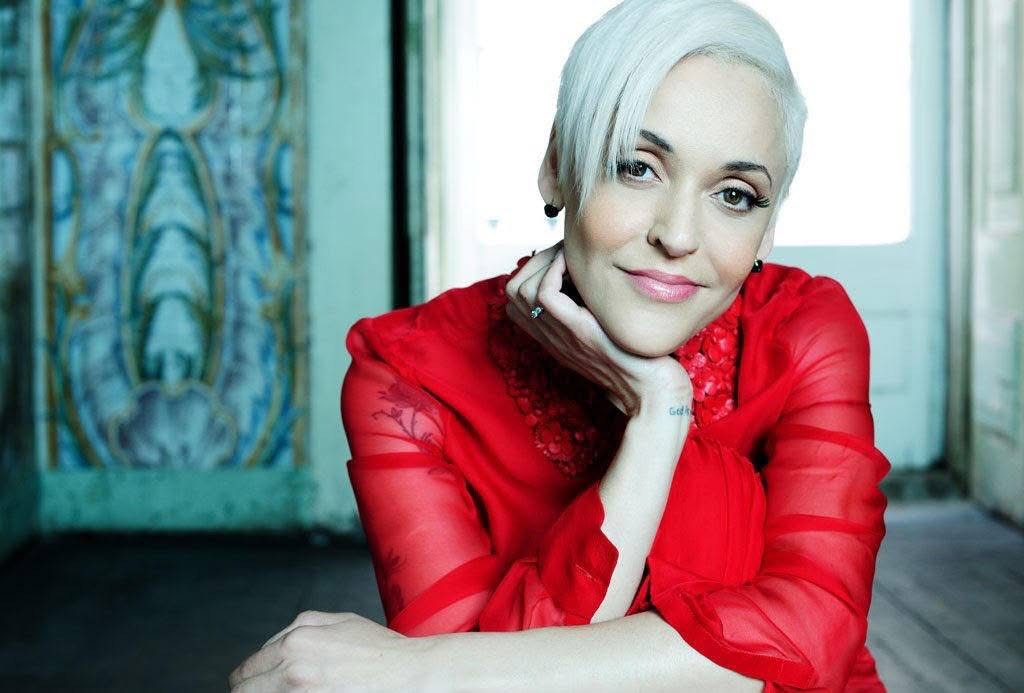

The Los Angeles Times called her voice “hauntingly beautiful,” and her songs have found their way into a Marvel series, a Nicole Kidman drama, cartoons with over a billion views, and concert stages around the world. Meet Marina V — singer, pianist, and songwriter, who left Moscow for America at fifteen with nothing but a scholarship and a very big dream.
Today, she has more than 1,600 concerts behind her, hundreds of Twitch streams, 14 independently released albums, an award presented by Sir Bob Geldof, and a Hollywood Music in Media Award. She has shared the stage with Howard Jones, Beth Hart, and Macy Gray, written music for PEPSI and “Days of Our Lives,” and her Russian-language song “Runaway Train” can be heard in Marvel’s “Your Friendly Neighborhood Spider-Man” on Disney+.
Her latest album, “Labyrinthine Rose,” may be her most personal yet, featuring rock legends Bruce Kulick (KISS) and David Ellefson (Megadeth). It was born where great joy meets great loss: the birth of her daughter and the sudden passing of her father. Along the way, Marina gave Kylie Minogue’s classic a Russian voice for “Nine Perfect Strangers,” adapted nearly 300 “Kote Kitty” and “Blue Tractor” songs for English-speaking children, launched her own animated series, “Violet and Mikey,” and composed the theme for the new Immigrant Podcast.

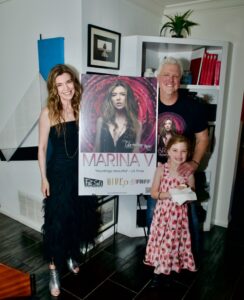
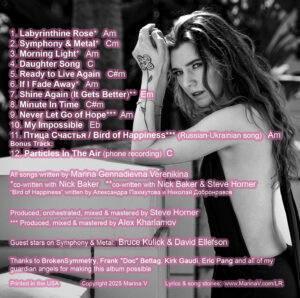
Mother, wife, immigrant, cultural ambassador, and an artist unafraid to speak about depression from the stage, Marina has a rare gift: she can make a room laugh, cry, and sing along — all in one evening. In her interview with Gorozhanka, she shares how she made it through the hardest years of her life, what it takes to translate Kylie Minogue into Russian, and what she would tell her fifteen-year-old self.
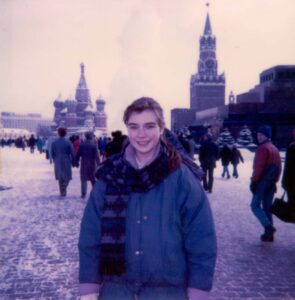
You came to the US at 15 on a scholarship. Do you remember your first days in America? What was the hardest part?
Coming to America at 15 was scary. I was an exchange student, and it was my first time away from my family — and my first time on an airplane. So many new people, everything new. At first, I was with a group of exchange students for an orientation in rural New York. Just a few days later, I was flying to meet my host family in Springfield, Illinois.
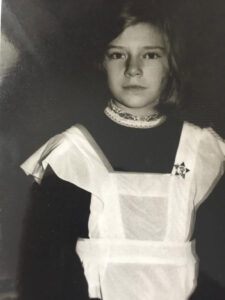
I had to concentrate so hard on speaking English that I had a headache every day — I’d forgotten that until I reread my journal. Of course, it was all very exciting, too. But I felt alone, and I missed my family terribly. I couldn’t even call them: this was before cell phones and video calls.
Your new album, “Labyrinthine Rose,” came out after the birth of your daughter and the sudden loss of your father. How did those events shape the songs?
Becoming a mother and then suddenly losing my dad during the pandemic happened within a very short time. Only later, in therapy, did I realize that I was experiencing a kind of existential grief.
So much in my life changed at once. I moved to a new town, had to stop touring after 20 years on the road, and even had to find a new community of friends who could relate to being a parent — all while going through perimenopausal changes that severely affected my sleep. I was a mess. But my amazing tiny daughter helped me see and appreciate the beauty in life.
I’ve always poured my feelings into songwriting; it’s a kind of therapy for me. These songs grew out of that period of grief, upheaval, and love — and that’s how “Labyrinthine Rose” came to be.
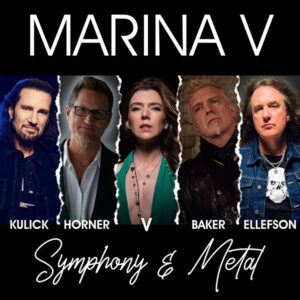
The album features Bruce Kulick (KISS) and David Ellefson (Megadeth). How did that collaboration come about?
Bruce Kulick and David Ellefson both play on “Symphony and Metal,” a song I wrote with my husband and collaborator, Nick. The song has a few layers: it’s about the complexity of life, how we can be fragile yet resilient — and about the two of us. I’m the symphony, since I’m classically trained, and he’s the metal, since he’s a big metal fan.
Because of the title, Nick thought it would be fun to bring metal musicians into the song. We’ve known Bruce and David for many years, and we both felt they’d be perfect for it. Thankfully, they said yes! They’re incredible musicians, wonderful people, and good friends, so the collaboration came together naturally.
For the symphonic side, we worked with the brilliant composer Steve Horner, known for his work on “Bridgerton” and with artists like Rachel Platten, among many others.
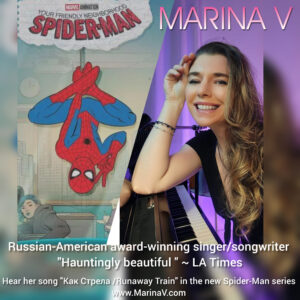
Your Russian-language song “Runaway Train / Я как стрела” is featured in Marvel’s “Your Friendly Neighborhood Spider-Man” on Disney+. How did that happen?
Over the years, I’ve written and sung songs for many film, television, and advertising projects. Russian is one of my specialties, and people in Hollywood know me for that work.
So when the company The Math Club was working on a song for Spider-Man, they asked me to translate it into Russian and sing it. Since it aired, I’ve heard from people all over the world — Russian speakers and non-Russian speakers alike — and the response has been incredible. I’m very honored to be even a small part of the Marvel Universe. Someone even made a Marvel Wiki page about me!
For “Nine Perfect Strangers,” starring Nicole Kidman, you wrote Russian lyrics for Kylie Minogue’s hit “Can’t Get You Out of My Head.” How hard is it to translate a song so that it still sings naturally?
Adapting a song into another language is definitely complicated. You have to make the meaning, mood, rhymes, rhythm, and phrasing all work — and make sure the lyrics feel natural to sing. You also have to navigate idioms and cultural nuances. Sometimes a catchy hook in one language simply doesn’t work in another.
I love that challenge, though. It feels like solving a fun puzzle. For the past five years, I’ve been honing those skills by adapting children’s songs for “Blue Tractor” and “Kote Kitty.”
You’ve adapted almost 300 songs into English for “Kote Kitty” and “Blue Tractor.” What’s the hardest thing to carry over from Russian children’s culture to American audiences?
One difference I’ve noticed is that Russian children’s songs are often more complex, musically and lyrically, than the simple, highly repetitive songs familiar to many American audiences. A good example is “Goluboy Vagon” from “Cheburashka,” with its beautiful melody, minor key, and poetic lyrics, compared with “The Wheels on the Bus,” which uses a simple major-key melody and a lot of repetition.
When I adapt Russian songs for English-speaking audiences, I try to bring a little more simplicity and repetition to the lyrics while staying as true to the original as I can. Finding that balance is the hardest part.
Now you have your own animated show, “Violet and Mikey,” created together with Artur Dneprovsky. How was the idea born, and what role does your daughter Violetta play in it?
I got into writing children’s music because of my daughter. When Violetta was a baby, I wanted to find high-quality Russian songs for her, since I’m raising her to be bilingual. That’s how I discovered “Blue Tractor.” The more we listened to the songs and watched the cartoons, the more impressed I became.
One day, I wrote to the YouTube channel to say how much I appreciated what they were creating — not only as a songwriter, but as a mom. I simply wanted to thank them for bringing something so wonderful into the world. The show’s creator and producer, Artur, wrote back. He’d been looking for someone to adapt the songs into English and asked if I’d be interested. It felt as if fate had brought us together.
After four years of adapting the songs, Artur suggested that we start a project of our own. That’s how “Violet and Mikey” was born. The characters’ names were inspired by our daughters: mine is Violetta, and Artur’s is Mika.
I’m very grateful to Artur for giving me the chance to discover a creative, silly side of myself I didn’t know was there. These joyful songs also brought me a lot of happiness while I was grieving the loss of my father.
You wrote the theme song for the Immigrant Podcast, produced by Larry Namer — the man who brought “Santa Barbara” to the USSR. What does the immigrant experience mean to you today?
I’m very proud to identify as an immigrant. It’s a huge part of who I am. People don’t always realize how difficult it can be to decide to leave your country and move to a completely different culture — to adapt, find your footing, and build a life in a new world.
Sharing my story can help people better understand and empathize with the immigrant experience, and that empathy is so important in today’s world. I’m excited to be part of The Immigrant Podcast by contributing its theme song. This podcast is so needed.
You speak openly about your struggles with depression. Why did you decide to share this with your audience, and what helps you now?
Sharing — through both my music and social media — has become an essential part of who I am. I share a lot of myself publicly: my struggles as well as my successes. I believe that when we show our vulnerable sides, we share our humanity. That helps us connect and empathize with one another — something we could all use more of in this world.
Talking openly about my struggles might also help someone else feel less alone, and feeling alone can be truly painful. Hearing about another person’s experience might even encourage someone to reach out for help and support.
How do you balance motherhood, so many projects, and your own music?
It’s a daily struggle, ha-ha! I’m just trying to do the best I can — for myself and for the people in my life.
What would you say to your 15-year-old self, just arriving in America?
I’d tell her to be kind to herself. Growing up, I wasn’t really taught to do that. I was taught to be “tough,” which often meant being too hard on myself.
Being tough can help you get through difficult things, but becoming a mom and learning new tools in therapy have helped me understand how important it is to treat yourself with kindness and empathy, too.
What are your plans for the coming year, and where can Gorozhanka readers hear your music?
I’m working on my 15th album, and I’ll be singing on a song for a popular video game. I’m also looking forward to playing more shows, both on Twitch and in person, making more music for “Violet and Mikey,” and continuing to learn how to be kind to myself.
You can find me at www.MarinaV.com, where you can sign up for music updates and find links to my social media and my music on Spotify, Apple Music, and more.